

Classification and Composition of Ceramic Particle Pneumatic Conveying Systems
For industrial applications involving the transport of ceramic particles, pneumatic conveying systems offer efficient and reliable solutions. These systems are categorized based on the flow characteristics and particle-air interaction, with each type tailored to specific operational requirements. Understanding the classification and composition of such systems is crucial for selecting the right equipment for material handling processes, as demonstrated by leading manufacturers like Shandong HeadPowder Engineering Co., Ltd., a company based in Shandong, China.

Classification of Ceramic Particle Pneumatic Conveying Systems
Ceramic particle pneumatic conveying systems can be broadly classified into three main categories: dilute phase, dense phase, and hybrid (or mixed phase) systems. Each classification is defined by the particle concentration in the conveying stream and the method of air-particle interaction.
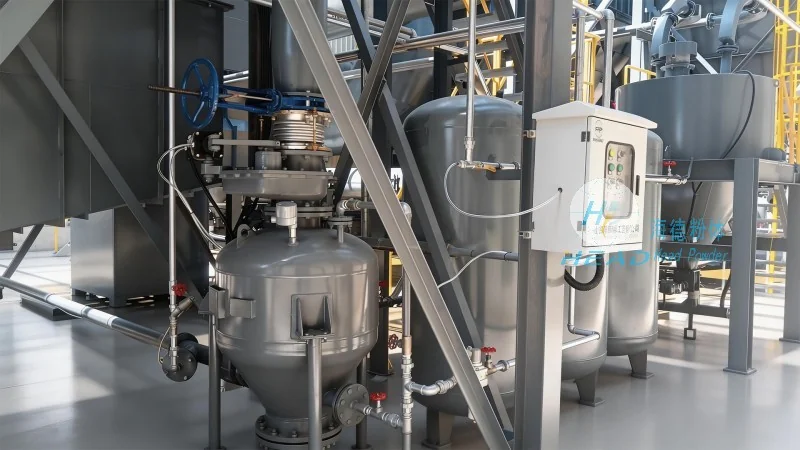
Dilute Phase Pneumatic Conveying
Dilute phase systems operate with low particle concentrations, typically ranging from 1% to 5% by volume. In this mode, particles are suspended in the air stream and transported through vertical or horizontal pipelines. This type of system is suitable for long-distance transport and applications where minimal pressure drop is required. The key components of a dilute phase system include a feed hopper, an air compressor, a conveying line, and a dust collector. The feed hopper ensures a consistent flow of ceramic particles into the system, while the air compressor provides the necessary pressure to move the particles. The conveying line transports the particles to the destination, and the dust collector removes any residual particles from the air stream.
Dense Phase Pneumatic Conveying
Dense phase systems, also known as low-velocity or high-pressure systems, operate with higher particle concentrations, usually between 10% to 30% by volume. In this mode, particles are carried in a slurry-like state, where the air acts as a carrier medium rather than a suspending agent. This method is ideal for transporting abrasive or fragile ceramic particles, as it minimizes particle attrition and reduces the risk of system blockages. The dense phase system typically consists of a positive displacement blower or a high-pressure compressor, a feed device, a conveying pipeline, and a separation unit. The positive displacement blower ensures a steady flow of air and particles, while the feed device controls the particle feed rate. The separation unit, such as a cyclone or a bag filter, separates the particles from the air stream at the end of the conveying line.

Hybrid (Mixed Phase) Pneumatic Conveying
Hybrid systems combine features of both dilute and dense phase operations. They operate with intermediate particle concentrations, typically between 5% to 15% by volume. This classification is used when the application requires a balance between the efficiency of dilute phase and the gentleness of dense phase. The hybrid system can be configured as a combination of a dilute phase section followed by a dense phase section, or as a single system with adjustable operating parameters. The components of a hybrid system include a variable-speed air compressor, a feed hopper with adjustable feed rates, a conveying line with variable pressure control, and a multi-stage separation system. This flexibility allows the system to adapt to varying particle sizes and flow rates, making it suitable for diverse industrial applications.