

Types and Practical Applications of Pneumatic Conveying Systems for Borax Granule Transport
Borax, a widely used chemical compound in industries such as glass manufacturing, detergents, and agriculture, often requires efficient and reliable transport methods for its granular form. Pneumatic conveying systems have emerged as a preferred solution for handling borax granules due to their ability to transport materials over long distances, with minimal mechanical wear and reduced product degradation. This article explores the various types of pneumatic conveying systems utilized in borax granule transport and their practical applications, highlighting the expertise of Shandong HeadPowder Engineering Co., Ltd. in providing tailored solutions for such industrial needs.
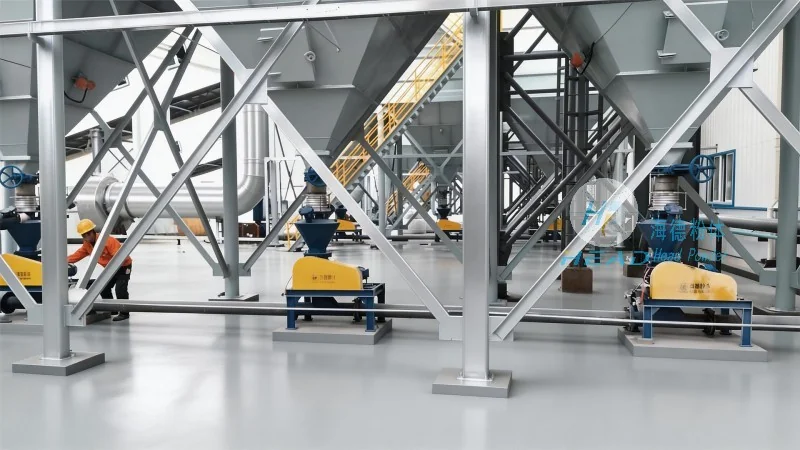
Types of Pneumatic Conveying Systems for Borax Granule Handling
There are primarily two main categories of pneumatic conveying systems: positive pressure and negative pressure systems. Each type has distinct characteristics and is suitable for different operational conditions and material properties.
Positive pressure systems, also known as pressure or blow-through systems, operate by forcing air or gas through the conveying line at a pressure higher than the ambient air pressure. This method is particularly effective for transporting borax granules over long distances or through complex layouts, as it can maintain consistent flow rates and prevent material settling in the pipeline. The system typically includes a blower, a hopper for material storage, and a discharge point where the material is released under pressure. Positive pressure systems are often preferred when the material is abrasive or has a high moisture content, as they can handle these challenges more effectively than negative pressure systems.
Negative pressure systems, or vacuum systems, operate by creating a vacuum in the conveying line, which draws the material from the source into the system. These systems are generally more suitable for shorter distances and less abrasive materials, as the vacuum can cause material to stick to the pipe walls, leading to blockages. However, for borax granules with lower abrasiveness and moderate moisture levels, negative pressure systems can be an economical choice. The system comprises a vacuum pump, a hopper, and a collection point where the material is discharged under vacuum. Negative pressure systems are often used in applications where the material needs to be transported from a single source to multiple destinations, as the vacuum can be maintained across multiple branches.

Mixed-mode or hybrid systems combine elements of both positive and negative pressure systems. These systems use a combination of pressure and vacuum to optimize material transport. For instance, a mixed-mode system might use a positive pressure blower to push material from the source to a central point and then use a vacuum to draw it to the destination. This approach is particularly useful for borax granule transport in complex industrial setups where both long-distance and short-distance transport is required. Mixed-mode systems offer flexibility and can adapt to varying operational conditions, making them a versatile choice for borax handling.
Practical Applications of Pneumatic Conveying Systems in Borax Granule Transport
The practical application of pneumatic conveying systems for borax granules varies depending on the specific industrial process and the scale of operation. In borax production facilities, these systems are commonly used to transport raw borax from storage silos to processing units, such as grinding and refining equipment. The efficiency of the system ensures that the material is moved quickly and with minimal loss, which is crucial for maintaining production throughput.

During the packaging stage, pneumatic conveying systems are employed to transfer borax granules from the processing line to packaging machines. This step requires precise control over the material flow to ensure accurate filling of bags or containers. The systems used in this phase are often equipped with adjustable flow control valves and filters to prevent clogging and maintain consistent product quality. For example, a positive pressure system might be used to transport borax granules from a hopper to a packaging line, where the material is metered and filled into bags under controlled pressure.
In addition to production and packaging, pneumatic conveying systems are also used in the distribution of borax granules from the manufacturing site to various customers. This involves transporting the material over longer distances, often from the plant to a warehouse or a shipping terminal. The choice of system in this scenario depends on the distance and the number of destinations. For long-distance transport, a positive pressure system with a high-capacity blower is typically used to ensure reliable delivery. For shorter distances with multiple destinations, a negative pressure system or a mixed-mode system might be more appropriate.
Another practical application is the handling of borax granules in recycling or reprocessing operations. In such cases, the material may have been previously processed and now needs to be transported back to the processing unit. Pneumatic conveying systems can effectively handle this material, as they can transport both clean and slightly contaminated granules without causing significant damage. The systems are often designed with additional filtration and cleaning mechanisms to maintain product purity during the transport process.