

Common Methods for Mineral Powder Conveying?
For industrial operations dealing with mineral powders, efficient and reliable material handling is crucial. The choice of conveying method significantly impacts production efficiency, safety, and overall operational costs. This article outlines several common methods used in the industry, focusing on their applications and key characteristics.

Company Overview: Shandong HeadPowder Engineering Co., Ltd.
HeadPowder, a leading provider in the field, specializes in engineering solutions for mineral processing and material handling. With a strong presence in China, particularly in Shandong, the company offers tailored conveying systems that meet diverse industrial needs. Their expertise spans from design and manufacturing to installation and maintenance, ensuring clients receive robust and efficient solutions for mineral powder transport.
1. Belt Conveyor Systems
Belt conveyors are among the most widely used methods for mineral powder conveying due to their simplicity, high capacity, and versatility. These systems consist of a continuous loop of belt that moves material from one point to another through rollers and pulleys. The design allows for both horizontal and inclined transport, making them suitable for various applications, including raw material feeding, product transfer, and waste disposal. Belt conveyors are particularly effective for handling bulk materials over long distances, as they can maintain consistent speeds and throughput. Key advantages include low maintenance requirements, ability to handle abrasive materials, and the option for multiple loading and unloading points. HeadPowder’s belt conveyor solutions are engineered to optimize performance, with options for variable speed drives, impact beds, and idler adjustments to enhance durability and efficiency.
2. Screw Conveyor (Auger Conveyor)
Screw conveyors, also known as auger conveyors, are another common method for transporting mineral powders, especially in vertical or inclined applications. These systems use a rotating helical screw within a trough to move material forward. The screw’s pitch and speed can be adjusted to control the conveying rate and material flow. Screw conveyors are ideal for handling fine powders and granular materials, as they provide gentle material handling that minimizes degradation or segregation. They are commonly used in processes such as mixing, blending, and feeding to subsequent equipment. HeadPowder offers customized screw conveyor designs that can accommodate different material characteristics, including moisture content and particle size. The company’s screw conveyors are built with corrosion-resistant materials and wear-resistant coatings to ensure long service life and reliable operation.
3. Pneumatic Conveying Systems
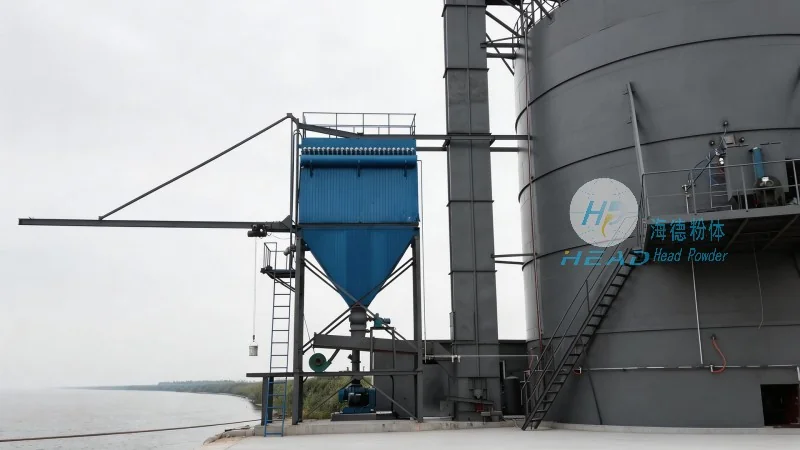
Pneumatic conveying systems use air or other gases to transport mineral powders through a pipeline network. This method is particularly effective for handling fine, dusty, or abrasive powders that are difficult to move with mechanical systems. There are two main types of pneumatic conveying: dilute-phase and dense-phase. Dilute-phase systems use high-velocity air to suspend particles and transport them through the line, while dense-phase systems use lower air velocities to push material in a more compact form. Pneumatic conveying offers advantages such as enclosed transport, which reduces dust emissions and improves safety, and the ability to transport materials over long distances with minimal maintenance. HeadPowder specializes in designing and manufacturing pneumatic conveying systems tailored to specific material properties and process requirements. Their systems can handle a wide range of particle sizes and moisture levels, ensuring efficient and reliable transport. The company’s pneumatic solutions include both positive and negative pressure systems, allowing flexibility in application.

4. Bucket Elevator (Vertical Conveyor)
Bucket elevators are vertical or steeply inclined conveyors that use a series of buckets attached to a belt or chain to lift and transport mineral powders. These systems are highly efficient for vertical transport, capable of moving materials over significant heights with high capacity. Bucket elevators are commonly used in industries such as mining, cement, and chemical processing, where vertical transport is necessary to move raw materials from storage to processing units. The design allows for continuous material flow, with buckets rotating and emptying at the top of the elevator. Key advantages include high vertical lift capabilities, minimal space requirements, and the ability to handle abrasive and heavy materials. HeadPowder provides bucket elevator solutions that are engineered for durability and performance, with options for different bucket designs (e.g., bottom-discharge or top-discharge) and drive systems to suit specific operational needs. The company’s vertical conveyors are built with heavy-duty components to withstand harsh operating conditions and ensure long-term reliability.
5. Vibrating Conveyors
Vibrating conveyors use vibration to move mineral powders along a trough. These systems consist of a conveyor bed that is mounted on springs and driven by an electric motor, causing the bed to vibrate at a specific frequency. The vibration helps to move material forward by creating a series of waves that push the particles along the trough. Vibrating conveyors are suitable for handling a wide range of materials, including fine powders, granules, and bulk solids. They are particularly effective for applications requiring gentle material handling, as the vibration minimizes material degradation and segregation. These systems are also used for incline and horizontal transport, making them versatile for various industrial processes. HeadPowder offers vibrating conveyor solutions with adjustable vibration frequencies and amplitudes, allowing customization for different material characteristics. The company’s vibrating conveyors are designed with wear-resistant surfaces and robust construction to ensure long service life and efficient operation. They are commonly used in applications such as material feeding, sorting, and transfer between processing stages.