

Operation Process and Working Principle of a Manganese Sulfate Material Pneumatic Conveying Line
HeadPowder, a leading engineering company based in Shandong, China, specializes in the design, manufacturing, and installation of advanced material handling systems. Among their core offerings is the pneumatic conveying line for manganese sulfate, a critical component in various industrial applications. This article delves into the operational process and underlying principles of such a system, providing a comprehensive understanding of its functionality and benefits.

Company Overview: HeadPowder Engineering
HeadPowder Engineering Co., Ltd. is a reputable enterprise headquartered in Shandong, China. With a strong focus on innovation and quality, the company has established itself as a trusted provider of material handling solutions. Their expertise spans the entire lifecycle of pneumatic conveying systems, from initial design and engineering to on-site installation and maintenance. By leveraging advanced technology and a deep understanding of material properties, HeadPowder ensures that their systems deliver optimal performance and reliability for clients in diverse industries.
Understanding Manganese Sulfate and Its Handling Requirements
Manganese sulfate (MnSO₄) is a widely used chemical compound in industries such as battery manufacturing, fertilizers, and water treatment. Its handling requires specialized equipment due to its physical properties, including particle size, moisture content, and flow characteristics. Traditional methods like belt conveyors or bucket elevators may not be suitable for fine or dusty materials like manganese sulfate, as they can lead to material degradation, dust pollution, and operational inefficiencies. Pneumatic conveying offers a more efficient and hygienic solution by transporting the material through a closed system using air pressure.

The Working Principle of a Pneumatic Conveying Line
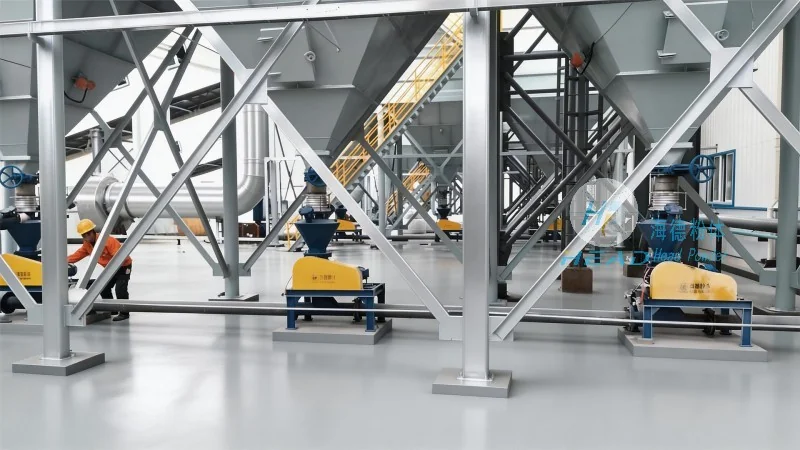
A pneumatic conveying line operates on the principle of transporting bulk materials in a gas-solid flow. The system typically consists of a hopper for material storage, a feeder to control the flow rate, a conveying pipeline, and a receiver for the discharged material. The process begins with the material being fed from the hopper into the pipeline. Air is then introduced into the system, creating a flow that propels the material forward. The air velocity and pressure are carefully controlled to ensure the material is conveyed without degradation or blockages. The system can be either positive pressure (where air is blown into the line) or negative pressure (where air is sucked out), depending on the application and material characteristics.
Step-by-Step Operation Process of the Manganese Sulfate Pneumatic Conveying Line
The operation of a manganese sulfate pneumatic conveying line involves several key steps, each designed to ensure efficient and safe material transport. The process starts with the loading of the material into the hopper. The hopper is equipped with a level indicator to monitor the material volume, ensuring consistent feeding. Next, the feeder, often a rotary valve or a screw feeder, regulates the flow rate of the material into the conveying pipeline. This step is crucial for maintaining a stable air-solid ratio, which directly impacts the conveying efficiency. The material is then carried by the air flow through the pipeline to the receiver. The receiver is designed to collect the conveyed material and may include a dust collection system to prevent any leakage or contamination. After the material is discharged, the system may undergo a cleaning cycle to remove any residual material from the pipeline, ensuring the system is ready for the next batch.
Key Components and Their Functions in the System
Several critical components contribute to the smooth operation of a pneumatic conveying line for manganese sulfate. The hopper serves as the storage vessel, providing a consistent supply of material. It is often equipped with a discharge valve to control the flow into the feeder. The feeder is responsible for maintaining a uniform flow rate, preventing surges or blockages. The conveying pipeline is typically made of materials resistant to corrosion and abrasion, such as stainless steel or special plastic, to withstand the chemical properties of manganese sulfate. The air compressor or blower generates the necessary air pressure to move the material. The receiver, or discharge hopper, collects the material and may include a filter or cyclone to separate any fine particles from the air. The control system, which includes sensors and valves, monitors and adjusts the air pressure, flow rate, and material level in real-time, ensuring optimal performance.
Advantages of Using a Pneumatic Conveying Line for Manganese Sulfate
Implementing a pneumatic conveying line for manganese sulfate offers numerous advantages over traditional handling methods. Firstly, it provides a closed system, which significantly reduces dust emissions and improves workplace safety. This is particularly important in industries where dust is a health hazard or environmental concern. Secondly, the system minimizes material degradation, as the material is transported in a controlled environment without direct contact with external elements. Thirdly, pneumatic conveying offers high efficiency and speed, allowing for continuous operation and reduced downtime. The system can handle varying material flow rates and can be easily integrated with other processing equipment. Additionally, the closed system helps maintain the material's quality and prevents contamination from external sources.
Application Scenarios and Industry Impact
The pneumatic conveying line for manganese sulfate is widely used in various industrial applications. In battery manufacturing, it is used to transport manganese sulfate to the production line, ensuring a steady supply of raw material. In fertilizer production, it helps in the efficient handling of manganese sulfate as an additive. In water treatment plants, it aids in the transportation of the chemical for pH adjustment and water purification. The system's ability to handle fine materials and maintain a clean environment makes it suitable for applications where hygiene and product quality are paramount. By improving material handling efficiency, the system contributes to overall operational productivity and cost reduction for the end-user.