

[Principle and Working Scene Characteristics of Fly Ash Bin Material Pneumatic Conveying Equipment]
Shandong HeadPowder Engineering Co., Ltd., a leading manufacturer based in Shandong, China, specializes in the design and production of advanced pneumatic conveying systems for industrial applications. The company's focus on innovation and precision engineering has positioned it as a trusted partner for clients seeking efficient and reliable solutions for handling fly ash and other bulk materials. This article explores the fundamental principles behind the fly ash bin material pneumatic conveying equipment, alongside the key characteristics of its operational scenarios.

Principle of Pneumatic Conveying for Fly Ash Handling
The core principle of pneumatic conveying systems involves the use of air or gas to transport bulk materials through a pipeline network. In the context of fly ash bin applications, this technology enables the efficient movement of fly ash from storage bins to processing units or disposal sites. The system typically comprises a hopper, a conveyor line, and a control unit. The hopper stores the fly ash, while the conveyor line uses compressed air to create a pressure differential that propels the material forward. The control unit regulates the air flow and pressure to ensure smooth and consistent material transport. This method offers several advantages over traditional mechanical conveying, including reduced maintenance costs, minimal material degradation, and the ability to handle materials with high moisture content or abrasive properties.
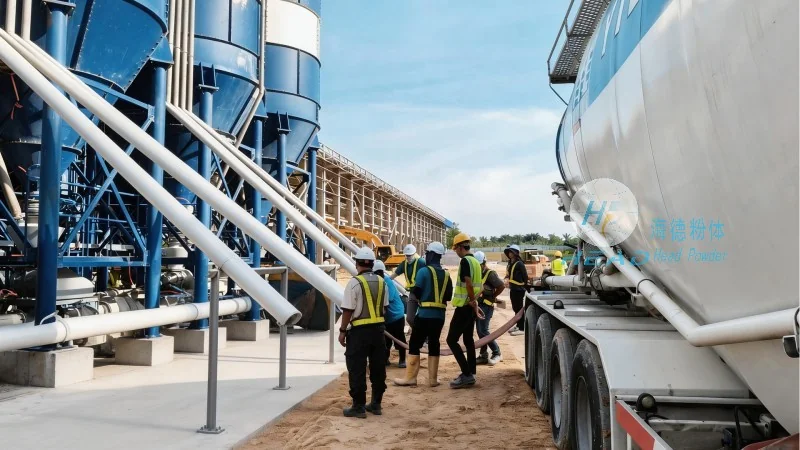
Key Working Scene Characteristics
The operational characteristics of fly ash bin material pneumatic conveying equipment are tailored to meet the demands of various industrial environments. One of the primary advantages is its adaptability to different site configurations, allowing it to be integrated into existing infrastructure with minimal disruption. The system's flexibility also enables it to handle varying material flow rates, from low to high throughput, making it suitable for both small-scale and large-scale operations. Additionally, the equipment is designed to minimize dust emissions, which is crucial for maintaining compliance with environmental regulations and ensuring workplace safety. The pneumatic conveying process also reduces the risk of material spillage and contamination, as the material remains enclosed within the pipeline system throughout its journey.

Applications and Performance Metrics
HeadPowder's fly ash bin material pneumatic conveying equipment is widely used in power plants, cement factories, and waste management facilities. The system's performance is evaluated based on several key metrics, including conveying capacity, pressure drop, and energy efficiency. The conveying capacity refers to the volume of material that can be transported per unit time, which is determined by factors such as the air velocity, pipeline diameter, and material properties. The pressure drop indicates the energy required to move the material through the system, with lower pressure drops signifying more efficient operation. Energy efficiency is another critical factor, as it directly impacts operational costs. The equipment is engineered to optimize these metrics, ensuring that clients achieve optimal performance while minimizing energy consumption.

Advantages Over Traditional Conveying Methods
Compared to traditional mechanical conveying methods, such as belt conveyors or screw conveyors, the pneumatic conveying system offers distinct advantages. Mechanical systems are prone to material buildup and wear, which can lead to increased maintenance and downtime. In contrast, pneumatic systems have fewer moving parts, reducing the risk of mechanical failure. Additionally, the enclosed pipeline design prevents dust and particulate matter from escaping into the environment, enhancing safety and compliance. The system's ability to handle a wide range of materials, including those with high moisture content or abrasive characteristics, makes it a versatile solution for diverse industrial needs. Furthermore, the pneumatic conveying process is more hygienic, as the material remains contained within the system, reducing the risk of contamination.