

Design of Light Calcium Negative Pressure Pneumatic Conveying Equipment
Light calcium (calcium carbonate) is a widely used industrial material in various sectors such as construction, chemical, and food processing. The efficient and reliable transportation of light calcium is crucial for maintaining production efficiency and product quality. Traditional methods like manual handling or mechanical conveyors often face challenges like dust pollution, material loss, and operational inefficiencies. To address these issues, the design of a negative pressure pneumatic conveying system specifically for light calcium has become essential. This article introduces the design principles, key components, and operational advantages of such a system, highlighting its application in industrial settings.

Company Overview: Shandong HeadPowder Engineering Co., Ltd.
Shandong HeadPowder Engineering Co., Ltd., commonly known as HeadPowder, is a professional manufacturer and supplier specializing in pneumatic conveying equipment. With years of experience in the industry, the company focuses on providing high-quality, customized solutions for material handling challenges. HeadPowder's expertise lies in designing and manufacturing equipment that meets the specific requirements of clients, ensuring durability, efficiency, and compliance with industry standards. The company's commitment to innovation and customer satisfaction has established it as a trusted partner in the material handling sector.
Key Components of the Light Calcium Negative Pressure Pneumatic Conveying System
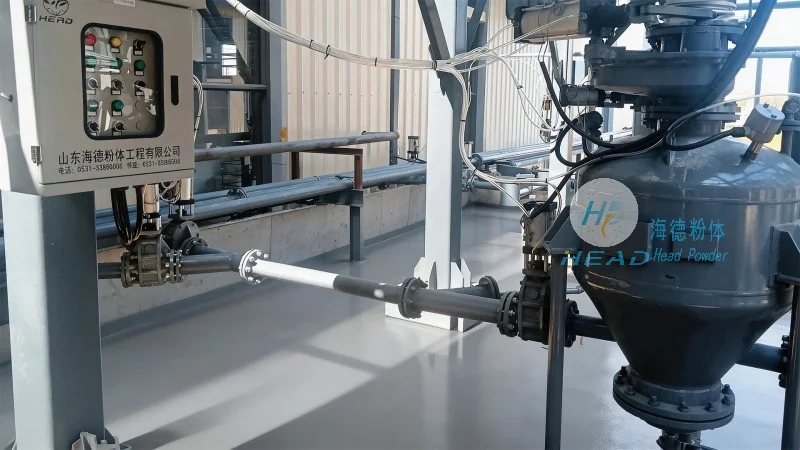
The light calcium negative pressure pneumatic conveying system consists of several critical components that work in tandem to achieve efficient material transport. The primary components include a material hopper, a rotary airlock valve, a vacuum pump, a filter system, and a discharge unit. The material hopper is designed to store light calcium and provide a controlled feed to the system. The rotary airlock valve acts as a seal to prevent air leakage and maintain the negative pressure within the system. The vacuum pump generates the necessary suction force to draw the material from the hopper and transport it through the pipeline. The filter system is crucial for capturing fine particles and preventing dust from escaping into the environment, ensuring compliance with environmental regulations. The discharge unit allows the material to be released at the destination point, completing the conveying process.
Design Considerations for Light Calcium Properties
Light calcium, with its fine particle size and low bulk density, presents unique challenges in pneumatic conveying. The design of the system must account for these properties to ensure optimal performance. The system is engineered to handle the low flow rates and high dust content typical of light calcium. The pipeline diameter and length are carefully selected to minimize pressure drop and energy consumption. The material hopper is designed with a sloped bottom to facilitate smooth material flow and prevent clogging. The rotary airlock valve is selected based on the material's particle size and flow characteristics to ensure reliable sealing and low pressure drop. The vacuum pump is chosen to provide sufficient suction capacity to overcome the resistance in the pipeline and maintain the negative pressure. These design considerations ensure that the system operates efficiently and safely, even with the challenging properties of light calcium.

Operational Advantages of the Negative Pressure System
Compared to positive pressure pneumatic conveying systems, the negative pressure system offers several advantages, particularly for light calcium transportation. The most significant advantage is the reduced risk of dust pollution and environmental contamination. Since the system operates under negative pressure, any leaks or failures result in air being drawn into the system rather than material escaping. This prevents dust from spreading into the workplace and the surrounding environment, improving air quality and safety. Another advantage is the lower energy consumption. Negative pressure systems typically require less power to operate compared to positive pressure systems, as they rely on the vacuum pump to create suction rather than forcing air through the pipeline. This leads to cost savings in energy consumption and operational expenses. Additionally, the negative pressure system is more suitable for transporting light calcium over longer distances, as the pressure drop is less critical compared to positive pressure systems. The system's ability to handle fine particles without clogging the pipeline also enhances its reliability and reduces maintenance requirements.

Application in Industrial Settings
The light calcium negative pressure pneumatic conveying system is widely used in various industrial applications where light calcium is a key component. In the construction industry, it is used to transport light calcium for the production of cement, plaster, and other building materials. The system ensures that the material is delivered to the production line without contamination or loss. In the chemical industry, light calcium is used as a filler or additive in various products, and the conveying system ensures a consistent supply of material to the processing units. In the food industry, light calcium is used as a food additive, and the system's design ensures that the material is handled in a hygienic and dust-free environment, meeting food safety standards. The system's flexibility allows it to be adapted to different production scales and layouts, making it suitable for both small-scale and large-scale industrial operations.
Conclusion
The design of a light calcium negative pressure pneumatic conveying system by Shandong HeadPowder Engineering Co., Ltd. represents a significant advancement in material handling technology. By addressing the unique challenges of light calcium transportation, the system provides efficient, reliable, and environmentally friendly solutions for industrial applications. The company's expertise in designing and manufacturing such equipment ensures that clients receive high-quality products that meet their specific needs. As the demand for efficient material handling continues to grow, the negative pressure pneumatic conveying system for light calcium remains a vital solution for maintaining production efficiency and product quality in various industries.