

Operation Process and Working Principle of Pneumatic Conveying for Straw Powder Materials
Straw powder materials are widely utilized across diverse industrial sectors, and efficient material handling is pivotal for optimizing production workflows. Pneumatic conveying systems have emerged as a reliable technology for transporting these materials, offering benefits such as low maintenance requirements, operational flexibility, and the capability to handle fine powders like straw powder. This article provides a comprehensive exploration of the operation process and working principle of pneumatic conveying for straw powder materials, alongside an introduction to HeadPowder, a company specializing in engineering solutions for such systems.

Overview of Pneumatic Conveying Systems for Straw Powder Materials
Pneumatic conveying systems leverage air or gas to transport bulk materials through a pipeline network. For straw powder, these systems are engineered to accommodate the material's specific characteristics, including its fine particle size, low bulk density, and propensity for dust generation. The system typically comprises a hopper for material storage, a blower or compressor to generate air flow, a pipeline system for material transport, and a discharge point for material collection. The design of the system is critical to ensure efficient and reliable operation, minimizing material loss and preventing blockages or clogging.

Key Components of the Pneumatic Conveying System
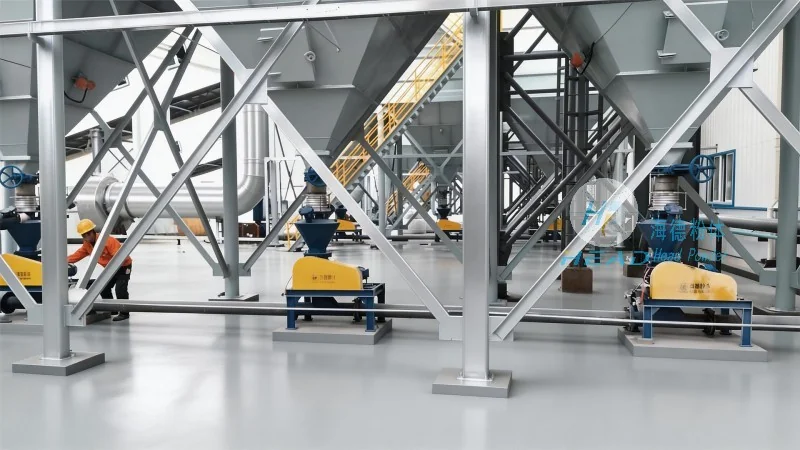
The effectiveness of a pneumatic conveying system for straw powder materials hinges on several key components. The hopper serves as the initial storage unit, where straw powder is loaded and prepared for transport. It is often equipped with a feeder, such as a rotary valve or screw feeder, to regulate the material flow rate into the pipeline. The blower or compressor is the core of the system, providing the necessary air pressure and volume to move the material. The pipeline system is constructed with appropriate diameter and material to withstand pressure and resist wear from the abrasive straw powder. Finally, the discharge point, which may include a cyclone separator or filter, is used to separate the material from the air stream and collect it in a receiving container.
Operation Process of Pneumatic Conveying for Straw Powder Materials
The operation process of a pneumatic conveying system for straw powder materials involves sequential steps. First, straw powder is loaded into the hopper from a storage silo or truck. The feeder then controls the flow rate of material into the pipeline, ensuring consistent input. The blower generates a high-pressure air stream, introduced into the pipeline at the hopper inlet. As the air flows, it picks up straw powder particles, forming a dense or dilute phase mixture based on system design. The mixture travels through the pipeline to the discharge point, where air and material are separated. The separated air is typically filtered to remove residual dust, and straw powder is collected in the receiving container. The system operates continuously, with the blower running to maintain air flow and the feeder controlling material input.
Working Principle of Pneumatic Conveying for Straw Powder Materials
The working principle of pneumatic conveying for straw powder materials is based on the interaction between air flow and material particles. In a dilute phase system, material is suspended in the air stream as individual particles, akin to a gas-solid mixture. The air velocity must be sufficient to keep particles suspended and prevent settling. In a dense phase system, material is transported in a slurry-like state with higher concentration and lower air velocity. The choice between dilute and dense phase depends on material characteristics, pipeline length, and desired efficiency. System efficiency is influenced by factors like air pressure, flow rate, material feed rate, and pipeline design. Proper maintenance and calibration of components are essential to ensure optimal performance and minimize operational issues.

About HeadPowder: Engineering Solutions for Pneumatic Conveying Systems
HeadPowder, a leading engineering company headquartered in Shandong, China, specializes in the design, manufacturing, and installation of pneumatic conveying systems for various bulk materials, including straw powder. With extensive industry experience, HeadPowder has developed advanced solutions tailored to the unique challenges of handling fine powders like straw. The company's team of engineers and technicians collaborate closely with clients to understand specific material handling needs and provide customized system designs that meet operational requirements. HeadPowder's commitment to quality and innovation has established it as a trusted partner for businesses seeking reliable and efficient pneumatic conveying solutions. The company's headquarters is located in Shandong, China, offering local support and service to its clients.