

Operation Process and Working Principle of Rice Husk Ash Powder Pneumatic Conveying Line
HeadPowder, a leading enterprise in the field of powder handling technology, specializes in the design, manufacturing, and implementation of advanced pneumatic conveying systems. This article provides a detailed overview of the operation process and working principle of a rice husk ash powder pneumatic conveying line, highlighting the key components, operational steps, and technical aspects that ensure efficient and reliable material transport.

Overview of the Pneumatic Conveying System
The rice husk ash powder pneumatic conveying line is engineered to handle fine powders like rice husk ash, which are often challenging to transport due to their light weight and potential for dust generation. The system is designed by Shandong HeadPowder Engineering Co., Ltd., a company based in Shandong, China, with a strong reputation for delivering high-quality industrial solutions. The primary goal of this system is to move the powder from a storage silo or hopper to a processing unit or storage location with minimal loss and maximum efficiency.
Key Components of the Pneumatic Conveying Line
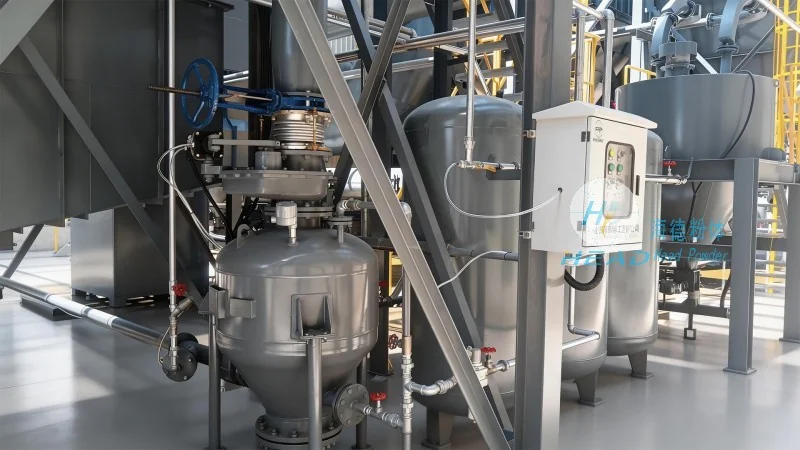
The pneumatic conveying line consists of several critical components that work in tandem to achieve the desired material transport. These components include a silo or hopper for material storage, a feeder to control the flow rate, a compressor or blower to generate the necessary air pressure, a pipeline system for transporting the powder-air mixture, and a receiver or destination vessel for the material. Each component plays a vital role in the overall operation, and their proper integration is crucial for the system's performance.

Working Principle of the Pneumatic Conveying Process
The operation of the rice husk ash powder pneumatic conveying line is based on the principle of pneumatic transport, where the powder is suspended and carried by a stream of air. The process begins with the material being discharged from the storage silo into the feeder. The feeder then regulates the flow of rice husk ash into the pipeline, ensuring a consistent feed rate. Simultaneously, the compressor or blower generates high-pressure air, which is introduced into the pipeline. As the air flows through the pipeline, it creates a negative pressure or positive pressure environment, depending on the system design, to draw the powder particles into the air stream.
The powder particles are then suspended in the air and transported along the pipeline to the receiver. The velocity of the air and the size of the powder particles determine the efficiency of the conveying process. Proper design of the pipeline, including the use of bends, elbows, and straight sections, is essential to minimize pressure drop and prevent material deposition or blockage. The receiver at the end of the pipeline collects the conveyed powder, which can then be used for further processing or storage.
Operation Process: Step-by-Step Guide
The operation of the rice husk ash powder pneumatic conveying line follows a systematic sequence of steps to ensure smooth and continuous material transport. The process starts with the preparation phase, where the storage silo is filled with rice husk ash, and the system is checked for any leaks or malfunctions. Once the system is ready, the feeder is activated to start the material flow. The compressor is then turned on to generate the required air pressure, and the conveying process begins.
During the conveying operation, the system's pressure and flow rates are monitored continuously to ensure optimal performance. Any adjustments to the feeder speed or compressor output are made as needed to maintain a stable flow of powder. The receiver is checked periodically to ensure it is not overfilled, and the system is stopped if any issues arise, such as blockages or excessive pressure drop.
The process concludes when the material has been fully transferred from the storage silo to the receiver. The system is then shut down, and the receiver is emptied as required. Regular maintenance is performed to keep the system in good working condition, including cleaning the feeder, checking the compressor filters, and inspecting the pipeline for any signs of wear or damage.

Advantages of the Pneumatic Conveying Line
The rice husk ash powder pneumatic conveying line offers several advantages over traditional mechanical conveying methods. These include the ability to transport fine powders over long distances without the need for multiple transfer points, reduced risk of material contamination due to enclosed systems, and lower maintenance requirements compared to mechanical systems. The system also provides better control over the flow rate and pressure, which is essential for handling sensitive materials like rice husk ash.
Conclusion
Shandong HeadPowder Engineering Co., Ltd. has successfully developed and implemented a reliable and efficient rice husk ash powder pneumatic conveying line that meets the needs of modern industrial applications. The system's operation process and working principle are based on proven pneumatic transport technology, ensuring high performance and durability. With its headquarters in Shandong, China, HeadPowder continues to innovate and provide high-quality solutions for powder handling challenges, helping industries to improve their operational efficiency and reduce costs.