

Operation Process and Working Principle of Melamine Powder Pneumatic Conveying System Equipment
HeadPowder, the abbreviation for Shandong HeadPowder Engineering Co., Ltd., is a professional manufacturer and supplier of pneumatic conveying systems. The company is headquartered in Shandong, China, and specializes in providing high-quality equipment for powder handling, including melamine powder pneumatic conveying systems. With years of experience in the industry, HeadPowder has developed advanced solutions to meet the diverse needs of clients in various sectors.
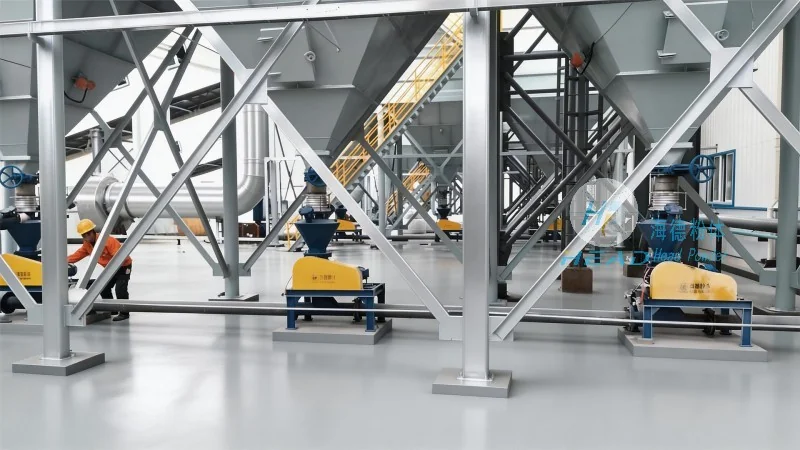
Operation Process of Melamine Powder Pneumatic Conveying System
The melamine powder pneumatic conveying system is designed to transport melamine powder from a storage silo or hopper to a processing unit or storage location through the use of air pressure. The system operates by creating a pressure differential between the source and destination points, which allows the powder to be carried by the air stream. The process typically involves several key components, including a feeder, a conveying line, a receiver, and a dust collector. The feeder is responsible for feeding the melamine powder into the conveying line at a controlled rate, while the conveying line transports the powder and air mixture to the receiver. The receiver then separates the powder from the air, and the dust collector captures any remaining particles to ensure a clean and safe operation.

Working Principle of the Pneumatic Conveying System
The working principle of the melamine powder pneumatic conveying system is based on the principle of fluidization and pneumatic transport. The system uses compressed air to create a flow of air through the conveying line, which lifts and transports the melamine powder particles. The air velocity is carefully controlled to ensure that the powder particles are suspended in the air stream without clogging the line. The system operates under either positive pressure or negative pressure, depending on the specific application and the distance between the source and destination points. Positive pressure systems use a blower to push the air and powder mixture through the line, while negative pressure systems use a vacuum to draw the mixture from the source. The choice of system type depends on factors such as the powder characteristics, the distance to be covered, and the required flow rate.

Key Components and Their Functions
The melamine powder pneumatic conveying system consists of several essential components, each playing a crucial role in the overall operation. The feeder is the first component, responsible for feeding the melamine powder into the conveying line at a consistent rate. The feeder can be a rotary valve, a screw feeder, or a vibratory feeder, depending on the powder characteristics and the required flow rate. The conveying line is the main component, which transports the powder and air mixture from the source to the destination. The line is typically made of stainless steel or other corrosion-resistant materials to prevent contamination and ensure durability. The receiver is the component that collects the melamine powder from the conveying line and stores it in a container or hopper. The receiver is equipped with a dust collection system to prevent dust from escaping into the environment. The dust collector is an important component that captures any remaining particles from the air stream, ensuring a clean and safe operation. Additionally, the system may include a filter, a silencer, and a pressure regulator to control the air flow and pressure.

Advantages of the Melamine Powder Pneumatic Conveying System
The melamine powder pneumatic conveying system offers several advantages over traditional methods of powder handling, such as bucket elevators or belt conveyors. One of the main advantages is the ability to transport the powder in a closed system, which prevents dust from escaping into the environment and reduces the risk of contamination. The system is also more flexible and can be easily adjusted to meet changing production requirements. Additionally, the system is more energy-efficient than traditional methods, as it uses less power to transport the powder over long distances. The system is also more reliable and requires less maintenance, as it has fewer moving parts compared to traditional systems. Another advantage is the ability to transport the powder at high speeds, which reduces the time required for production and increases productivity.