

What is a Graphite Lumps Pneumatic Conveying System? And What Are Its Design Principles?
Graphite is a versatile material widely used in various industries due to its excellent electrical conductivity, thermal stability, and lubricating properties. When graphite is processed into lumps or granules, efficient and reliable material handling becomes crucial. Pneumatic conveying systems offer an effective solution for transporting graphite lumps over short to medium distances, ensuring minimal product degradation and maintaining the material's integrity. This article explores the concept of a graphite lumps pneumatic conveying system and delves into its fundamental design principles.

Understanding Pneumatic Conveying Technology
Pneumatic conveying systems utilize compressed air or gas to transport bulk materials through a pipeline. Unlike mechanical conveyors, which rely on mechanical components like belts or screws, pneumatic systems use air pressure to move the material. This method is particularly suitable for materials like graphite lumps, which can be abrasive or sensitive to mechanical stress. The system typically consists of a hopper for material storage, a feeder to control the flow rate, a conveying line, and a receiver for the discharged material. The choice of conveying type—such as dilute phase or dense phase—depends on the material characteristics and the required conveying distance.

Key Components of a Graphite Lumps Pneumatic Conveying System
The design of a graphite lumps pneumatic conveying system involves several critical components, each playing a vital role in the overall operation. The hopper serves as the storage vessel, holding the graphite lumps before they are fed into the system. It is designed to prevent material bridging and ensure a consistent flow. The feeder, often a rotary valve or a screw feeder, regulates the material discharge rate, preventing overloading of the conveying line. The conveying line is made of materials resistant to graphite's abrasive nature, such as stainless steel or special alloys, to minimize wear and maintain system efficiency. The receiver is where the material is deposited after being conveyed, and it is equipped with a dust collection system to control airborne particles and ensure environmental compliance.

Design Principles for Optimal Performance
The design of a graphite lumps pneumatic conveying system must consider several factors to ensure efficient and reliable operation. The first principle is the selection of the appropriate conveying velocity. The velocity must be high enough to prevent material settling in the line but low enough to avoid excessive wear on the pipeline and components. The velocity is typically determined based on the material's density, particle size, and the required conveying distance. Another critical principle is the pressure drop across the system. The pressure drop is influenced by the length of the conveying line, the number of bends, and the size of the components. Proper design minimizes pressure drop to reduce energy consumption and ensure consistent material flow. Additionally, the system must be designed to handle the abrasive nature of graphite lumps, using materials and components that can withstand the wear and tear. This includes using lined pipes, wear-resistant valves, and regular maintenance schedules to prolong the system's lifespan.
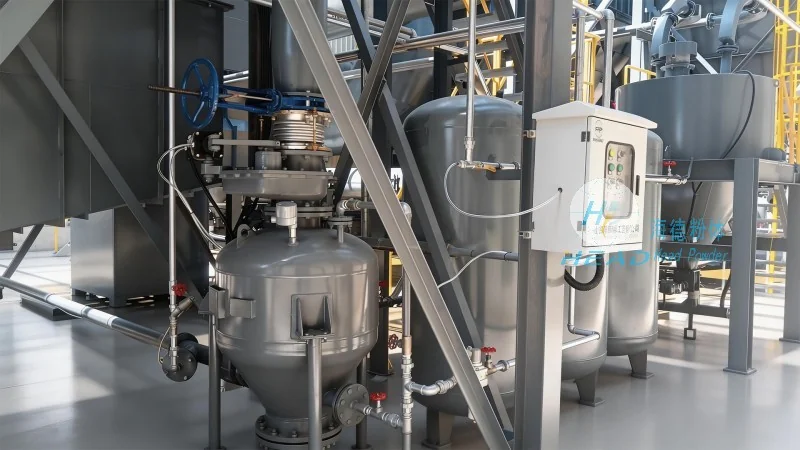
Applications and Benefits of Graphite Lumps Pneumatic Conveying Systems
Graphite lumps pneumatic conveying systems are widely used in industries such as refractories, batteries, and lubricants. The systems are particularly beneficial in applications where the material needs to be transported from one processing stage to another without degradation. The benefits of using a pneumatic conveying system for graphite lumps include reduced product contamination, lower maintenance costs compared to mechanical systems, and the ability to handle materials in a closed system, minimizing dust emissions. The system's flexibility allows for easy integration into existing production lines, and its compact design saves space in industrial facilities. Additionally, the system can be customized to meet specific process requirements, such as varying conveying capacities or distances.