

What is Quartz Stone Powder Pneumatic Conveying? And What Are Its Design Principles?
Quartz stone powder pneumatic conveying is a technology used to transport fine powders, such as quartz stone powder, through a pipeline using compressed air or other gas as the conveying medium. This method offers an efficient and flexible solution for handling materials that are difficult to transport via traditional methods like gravity or mechanical conveyors. The design principles behind such systems are crucial for ensuring reliable operation, minimizing material degradation, and optimizing energy consumption.

Understanding Pneumatic Conveying Systems
Pneumatic conveying systems operate by creating a pressure differential between the inlet and outlet of the conveying line. The system typically consists of a hopper to store the powder, a blower or compressor to generate the necessary air pressure, and a pipeline network to transport the material. The choice of conveying type—whether it's pressure or vacuum—depends on factors like the distance, material characteristics, and required flow rate. For quartz stone powder, which is often abrasive and fine, a well-designed system must account for these properties to prevent clogging and equipment wear.
Design Principles of Quartz Stone Powder Pneumatic Conveying
The design of a quartz stone powder pneumatic conveying system involves several key principles aimed at maximizing efficiency and durability. First, the selection of the conveying type is critical. Pressure systems, where air is forced into the line, are suitable for long-distance transport and high-volume applications, while vacuum systems are better for short distances or when the material needs to be collected from multiple sources. For quartz stone powder, which has a high density and can be prone to agglomeration, a pressure system with positive displacement blowers is often preferred to maintain consistent flow and prevent blockages.
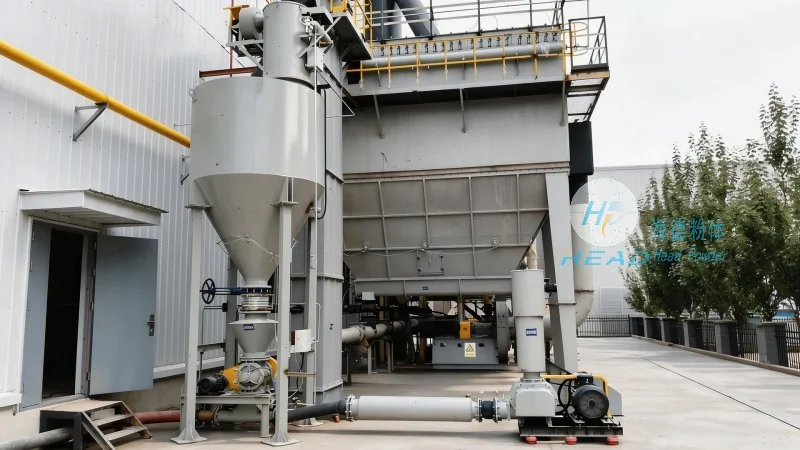
Second, the system's components must be chosen to withstand the abrasive nature of quartz stone powder. Materials like stainless steel or special alloys are commonly used for the hopper, blower housing, and pipeline to prevent wear and corrosion. The design also considers the particle size distribution of the powder; finer particles require higher air velocities to maintain suspension, while larger particles may need larger ducts to avoid excessive pressure drops.
Key Components and Their Functions
A typical quartz stone powder pneumatic conveying system includes several essential components, each playing a vital role in the overall operation. The hopper serves as the storage vessel, allowing for continuous feeding of the powder into the system. It is equipped with a feeder, such as a rotary valve or a screw feeder, to control the flow rate and prevent material buildup. The blower or compressor generates the compressed air that propels the powder through the pipeline. The pipeline network, made of durable materials, transports the material from the hopper to the discharge point, which may be a silo, storage tank, or processing unit.

The cyclone separator is another critical component, used to separate the powder from the air at the discharge end. As the air and powder mixture enters the cyclone, the centrifugal force causes the heavier powder particles to be deposited into a collection bin, while the air is discharged through a vent. This separation process is essential for recovering the material and maintaining the efficiency of the system. Additionally, filters may be included to capture any fine particles that escape the cyclone, ensuring clean air discharge and preventing environmental contamination.
Application Scenarios and Benefits
Quartz stone powder pneumatic conveying is widely used in various industries, including construction, manufacturing, and chemical processing. In the construction industry, it is used to transport quartz stone powder for concrete production, where consistent material quality is essential. The manufacturing sector employs this technology for processing quartz stone into fine powders for use in coatings, adhesives, and other products. The benefits of pneumatic conveying include reduced labor costs, as it eliminates the need for manual handling, and improved material quality, as the system minimizes exposure to moisture and contamination.

Another significant advantage is the flexibility of the system. It can be easily integrated into existing production lines and adapted to different material characteristics. The ability to transport materials over long distances without the need for intermediate storage points also enhances operational efficiency. For quartz stone powder, which is often produced in large quantities, pneumatic conveying allows for continuous, automated processing, reducing downtime and increasing overall productivity.
Conclusion and Company Information
Quartz stone powder pneumatic conveying is a sophisticated technology that combines engineering principles with material science to achieve efficient material transport. The design principles, including the selection of conveying type, component materials, and system layout, are tailored to the specific properties of quartz stone powder, ensuring reliable and sustainable operation. As a leading provider in this field, Shandong HeadPowder Engineering Co., Ltd. specializes in designing and manufacturing customized pneumatic conveying systems that meet the unique needs of clients. With a focus on durability, efficiency, and innovation, HeadPowder offers solutions that enhance productivity and reduce operational costs for businesses handling quartz stone powder. Based in Shandong, China, HeadPowder leverages its expertise to deliver high-quality equipment and services to industries worldwide.