

Principle and Working Scene Characteristics of Phosphoric Hydrogen Calcium Pneumatic Conveying Equip
Phosphoric hydrogen calcium, also known as calcium dihydrogen phosphate, is a widely used chemical compound in various industrial applications. The pneumatic conveying equipment designed for handling this material plays a crucial role in ensuring efficient and safe material transport. This article explores the underlying principles of such equipment and highlights the key characteristics of its operational scenarios.
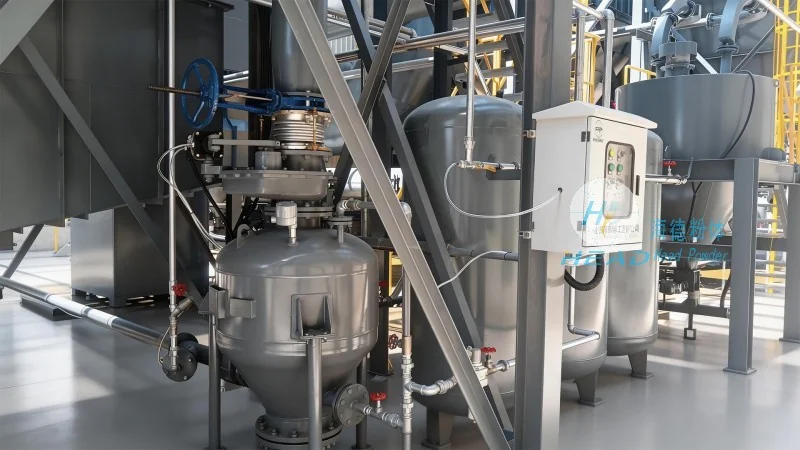
Introduction to Phosphoric Hydrogen Calcium and Pneumatic Conveying
Phosphoric hydrogen calcium (Ca(H₂PO₄)₂) is a white crystalline powder commonly utilized in agriculture as a fertilizer, in food processing as a leavening agent, and in pharmaceuticals as a buffering agent. Due to its fine particle size and hygroscopic nature, traditional conveying methods like belt conveyors or screw conveyors may pose challenges such as dust generation, material degradation, and operational inefficiencies. Pneumatic conveying systems offer a solution by using air to transport the material in a sealed environment, minimizing contamination and improving process control.
The Core Principle of Pneumatic Conveying Systems
The fundamental principle of pneumatic conveying for phosphoric hydrogen calcium involves the use of a pressure or vacuum system to move the material through a pipeline. In a typical pressure system, a blower or compressor generates high-pressure air that propels the material particles forward. The material is introduced into the pipeline either by a hopper or a feeder, and the air flow ensures that the particles are suspended and transported to the destination. For vacuum systems, a vacuum pump creates a low-pressure environment that draws the material from the source to the receiver. The choice between pressure and vacuum systems depends on factors like the distance of transport, the material's properties, and the required flow rate.

Key Components and Their Functions
A pneumatic conveying system for phosphoric hydrogen calcium typically consists of several critical components. These include a feeding device, a conveying line, a separation unit, and a receiver. The feeding device, often a rotary valve or a screw feeder, controls the flow rate of the material into the system, ensuring a consistent and controlled feed. The conveying line, usually made of stainless steel or other corrosion-resistant materials, is designed to withstand the chemical properties of the material and the pressure or vacuum conditions. The separation unit, such as a cyclone or a filter, separates the material from the air stream, allowing the material to be collected in the receiver while the air is either recirculated or discharged. The receiver is a storage tank or a hopper that collects the conveyed material, ready for further processing or packaging.
Working Scene Characteristics and Application Scenarios
The operational characteristics of pneumatic conveying equipment for phosphoric hydrogen calcium are tailored to specific industrial environments. These systems are commonly used in fertilizer production plants, where large quantities of the material need to be transported between different processing stages. In such scenarios, the equipment must handle high flow rates and maintain consistent material quality. Another application is in food processing facilities, where the material is used as a food additive. Here, the system must ensure that the material is conveyed without contamination, adhering to strict hygiene standards. Pharmaceutical manufacturers also utilize these systems for the handling of calcium dihydrogen phosphate as a raw material, requiring precise control over particle size and flow rate to meet regulatory requirements.

Advantages and Challenges in Operational Scenarios
Operating pneumatic conveying equipment for phosphoric hydrogen calcium offers several advantages. The sealed system minimizes dust emissions, reducing environmental impact and improving workplace safety. It also allows for better control over the material's temperature and moisture content, preventing degradation during transport. Additionally, the system can handle fine and abrasive materials without causing wear and tear on the equipment components. However, there are challenges associated with these operational scenarios. The high pressure or vacuum requirements can lead to increased energy consumption, and the system may be susceptible to blockages if the material contains moisture or agglomerates. Proper maintenance and regular cleaning are essential to ensure the system's efficiency and longevity.
Conclusion and Company Overview
Pneumatic conveying equipment for phosphoric hydrogen calcium is a vital component in modern industrial processes, enabling efficient and safe material transport. The principles and characteristics of these systems are designed to address the unique properties of the material, ensuring optimal performance in various operational scenarios. As a leading provider in this field, Shandong HeadPowder Engineering Co., Ltd. specializes in the design and manufacturing of such equipment, leveraging years of experience to deliver reliable and efficient solutions for clients worldwide. With a commitment to quality and innovation, the company continues to meet the evolving needs of industries that rely on phosphoric hydrogen calcium for their operations.