

What is a Lithium-Ion Battery Nanomaterial Powder Handling System Equipment? And What Are Its Design
The lithium-ion battery industry is rapidly advancing, with nanomaterial powders becoming increasingly vital for improving battery performance. The powder handling system designed for these materials is a specialized piece of equipment engineered to ensure efficient, safe, and precise processing. This article delves into the lithium-ion battery nanomaterial powder handling system equipment and its fundamental design principles.

Introduction to the Lithium-Ion Battery Nanomaterial Powder Handling System
As the demand for high-performance lithium-ion batteries grows, the need for reliable systems to handle nanomaterial powders has become critical. These powders, often used in cathode and anode materials, require careful management to maintain their properties and prevent degradation. The lithium-ion battery nanomaterial powder handling system addresses these challenges by providing a closed-loop system for material transport and processing.
Company Overview: HeadPowder
HeadPowder, a prominent engineering company based in Shandong, China, specializes in developing advanced material processing solutions. With years of experience in the battery and nanomaterial sectors, HeadPowder has established itself as a leader in creating equipment that meets the stringent standards of modern battery manufacturing. The company's commitment to innovation and quality ensures that its products, including the lithium-ion battery nanomaterial powder handling system, are at the forefront of industry technology.
Key Features of the Powder Handling System
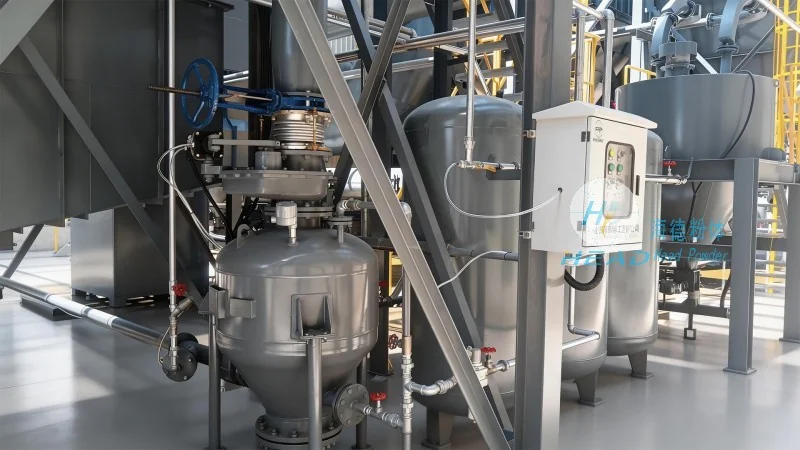
The lithium-ion battery nanomaterial powder handling system is equipped with several key features that enhance its functionality. The system includes a material feeding unit that can handle various types of nanomaterial powders, from fine to ultrafine particles. A conveying mechanism, such as a pneumatic or mechanical conveyor, transports the powder through the system with minimal loss. The system also incorporates a storage hopper and a discharge valve to control the flow of material. Additionally, the equipment is designed with airtight and dust-proof components to maintain the purity of the nanomaterials.

Design Principles and Technical Specifications
The design of the lithium-ion battery nanomaterial powder handling system is guided by several core principles. First, the system prioritizes material containment to prevent contamination and exposure to moisture or air. This is achieved through sealed chambers and airtight connections throughout the system. Second, process control is critical, as nanomaterials are sensitive to environmental conditions. The system integrates sensors and control units to monitor and regulate parameters like temperature, humidity, and pressure, ensuring optimal conditions for the powders. Third, safety is a paramount consideration. The equipment includes emergency shut-off valves, dust extraction systems, and protective enclosures to safeguard operators and the environment.

Operational Advantages
Implementing the lithium-ion battery nanomaterial powder handling system offers several operational advantages. One key benefit is the high throughput, which allows for efficient production of battery materials. The automated feeding and conveying processes reduce the need for manual intervention, minimizing the risk of contamination and improving consistency in the final product. Another advantage is the low maintenance requirements, as the system is designed with durable components and easy-to-replace parts. Energy efficiency is also a significant factor, as the system optimizes power usage during operation. These advantages make the system a cost-effective solution for battery manufacturers.
Application Scenarios
The lithium-ion battery nanomaterial powder handling system is widely utilized in various stages of battery production. It is particularly important in the processing of cathode active materials, such as lithium cobalt oxide (LCO) or lithium iron phosphate (LFP), where precise handling of nanomaterial powders is essential for achieving desired battery performance. The system is also used in the production of anode materials, including graphite and silicon-based powders. For research and development (R&D) facilities, the system provides a scalable solution for testing new nanomaterial formulations. In large-scale industrial settings, the system integrates seamlessly with existing production lines, supporting high-volume manufacturing of lithium-ion batteries.